
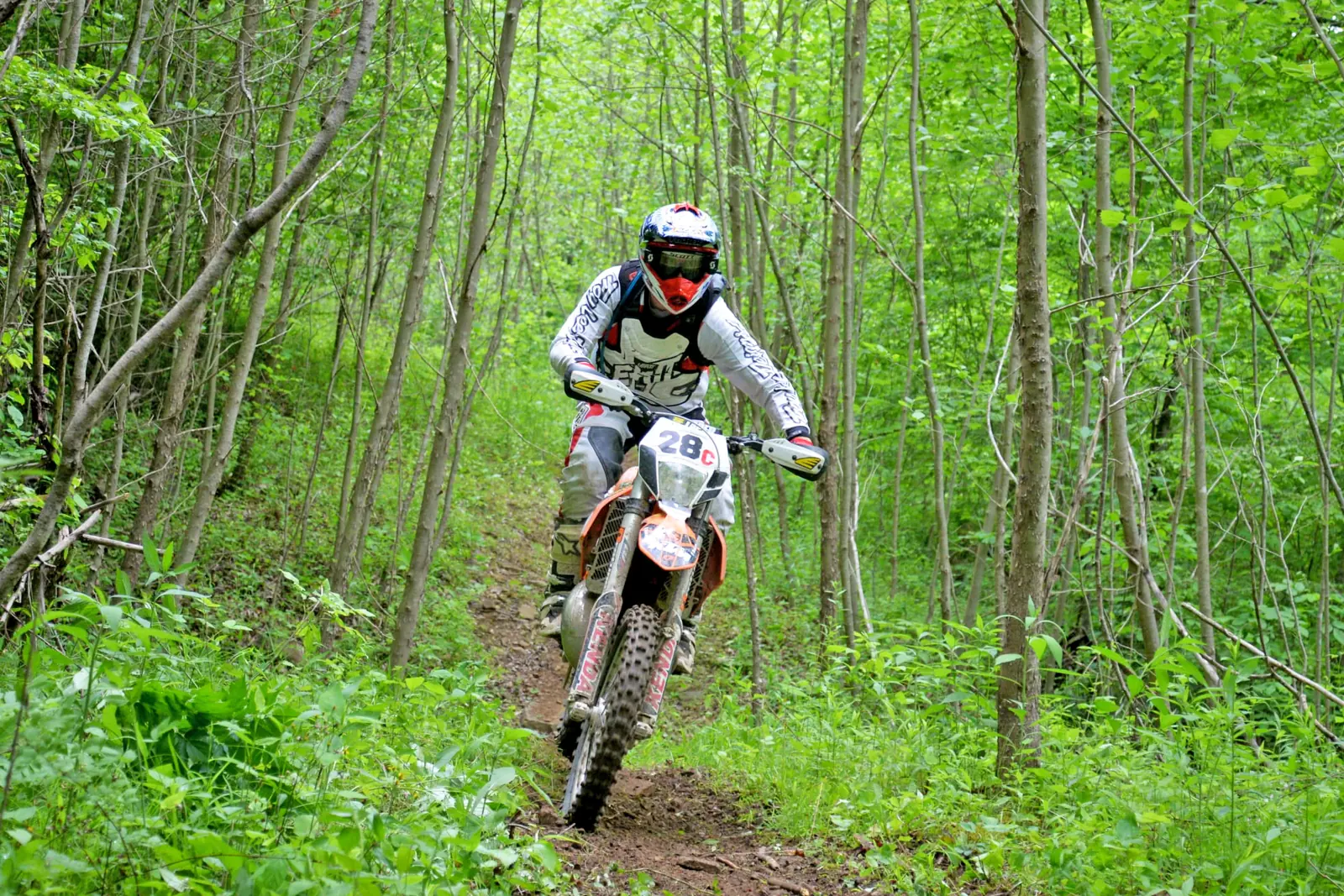
Traditional timekeeping
Timekeeping Enduro 101
Key time 10:00 a.m. 24 MPH average. This guide is for the traditional timekeeping style of enduros; the restart format is different.
A test against the clock and the terrain
A timekeeping enduro is not always a race of whoever is the fastest wins. It is a test against the clock and the terrain. The course of an enduro might be from 50-150 miles in length. An average ACES enduro is about 75 miles in length. You will ride very little, if any, of the same trail twice, therefore the course is fresh and not subject to breakdown, as seen with races that run continuous laps.
Items suggested
- Odometer
- Digital watch
- Route chart holder
- Scorecard holder
- Tape & scissors
Your first enduro
How the day goes
Tech and sign-up
When you pull in to the event location, you will need to unload your bike and proceed to tech inspection. You will then proceed to sign-up. There you will need your AMA card and entry fee. After paperwork is completed, you will need to draw for your row number for the day’s event. For example, you draw 20 – that means you will be on row 20 for this enduro. There will be three to five other riders on the row with you, so your number will be 20A for example. The other riders on the row will be 20B, 20C, 20D, etc. It is also possible that your row may not be full.
Your scorecard
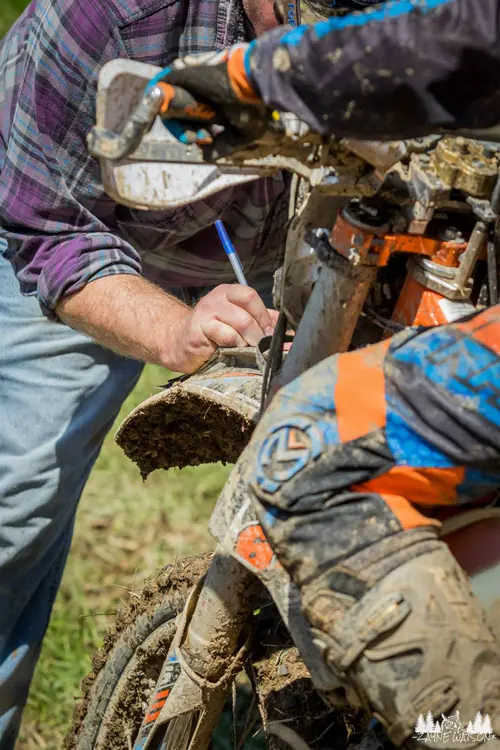
At sign-up, you were given a scorecard, this must be attached to the front fender of your bike. If your card is lost, a 10% penalty will be added to your score. Attach the card with all scoring blocks showing. The check crews during the event will write the time you arrive at each checkpoint in these spaces. At the end of the race, all scores are added up from this scorecard.
The route sheet
The route sheet that you got at sign-up shows the key time (time the event starts) as well as every major intersection on the course. Each turn will be listed numerically, followed by the direction of the turn, exact mileage and the time you will need to be at each turn. This chart will need to be cut into three-inch wide strips and taped together so it will fit in your route card holder. It is advised to run a strip of tape the entire length of the back of the route card before you wind it up. This really helps if it gets wet, when winding it forward during the race.
Route card example – 20 L 21.90 10:54:45. So the turn is 20, it is a left, and the mileage is 21.90, and you will need to be there at 10:54:45 a.m. There will be markers at each turn of the course to match up to as well.
Set your watch
Next thing to prepare is your digital watch: you will need to set your watch back 20 minutes, so it shows 10:00 when you leave the start line (because you drew row 20). The official start time of the enduro is called key time.
The speed average for most timekeeping enduros is a 24 MPH average, so that equals out to .4 (4 tenths) mile per minute of riding. Your time on the route chart is the exact time you need be at the marker. Now remember, you are riding through tight woods, rocks, hills, mud, other riders and all sorts of other obstacles that are doing their best to slow you down.
The start
It’s starting time! Your key time watch (watch set back for your row only) says 9:55: you have 5 minutes before you have to start. Hopefully, you are already geared up and can head down to the start line. You are responsible for leaving on time. If you are late, you will be scored as starting late — which means you already lose points. Here you need to make sure your odometer is set to zero. Row 19 leaves and you are next, the starting officials will write on your scorecard the time that you started and count down the start time for you.
It is always good to practice good riding etiquette: if a faster rider comes up behind you he will most likely yell a couple times to let you know he is there. Most likely he is not in your class, so it is good to let him around you and observe the way he rides. You can learn a lot from watching a better rider.
Your first check
First thing you will need to watch for is the 2.9 or odometer set mileage. It is simply a marker to help the riders calibrate their mileage to the bike the club used to mileage the course. Your mileage is good, so you continue down the trail according to your route card. There is a right turn at 4.26 miles. You arrive at that point and compare your time to the chart. You are late; don’t wait to pin it! Then, you come around a corner and see a red and white flag (printed on a metal sign) and a few people on the trail. You have made your first check.
The check workers will yell the time you arrived while someone writes it on your scorecard. They write a 23 — that means you are three minutes late, which means you just earned three points. (Points are not a good thing in enduros!)
Resets and free territory
You ride a little farther and come to a reset location. These are made to get you back on time to eliminate racing down public roads to the next section. Your reset is marked at 6.22 miles to reset to 8.22. So you have a 2 mile reset, which equates to a five minute reset period. If you are on time according to your route chart and watch, you may rest for five minutes. If you are still late three minutes, then you have two minutes to rest. You may leave early, but remember resets count as your minimum 3.2 miles between checks. It is possible to have another check 1.2 miles after this reset, as you already used up 2 miles of your 3.2.
In a 24 MPH format, the checks can be no closer than 3.2 miles, and possible check locations fall on specific mileages. For example, the old rule is 0, 4, 8 tenths will be on an even mileage and for an odd mileage checks will fall on 2, 6 tenths. So the possible check locations for 32 miles will be at 32.00 and 32.40 as well as 32.80. Easy huh?
Gas stops
After riding for some time, you will eventually find your way to a gas stop on the course. Your crew will need to be there to provide gas, drink, etc. A gas stop is basically a big reset. A gas stop provides time for a break. A gas available (not gas stop) on the other hand provides NO time, it is a true “splash and go” for gas. You will find both styles, but gas stops are more widely used.
The finish
You make it to the last check. The officials will let you know it is the end and take your scorecard and give a copy to you. They will begin to figure scores. You may as well add up your score, too. Remember one point for each minute late from your row 20. Two points for the first minute early and five points prior to that up to 15 minutes early. Hopefully you did not “burn” any checks.
So, you total up your score and you “dropped” 26 points. No early penalties. So, that’s really a good ride for your first enduro. You even get a trophy at the awards presentation. You are now hooked on the enjoyment of the true enduro sport!
Know your checks
Checks and scoring
One point is given for each minute you are late. If you’re more than 60 minutes late to a check, you have “houred out” and are disqualified. While arriving late is bad, arriving early can be even worse: two points for the first minute early, then five points for every minute early prior to that, so if you were three minutes early, you earned 12 points. Fifteen or more minutes early will get you disqualified. Basically, for average riders, if you watch your clock and enter the section on time you will never ride fast enough to burn the check (arrive early) at the other end.
Please be still for the checkers to write your score on the card. Avoid twitching, moving handlebars, revving engine etc. They will get you out as soon as possible. Remember it is your responsibility to get scored. If you miss a check or are not scored, it is an immediate disqualification.
Secret checkRed and white sign: scores you to the minute. Extra penalty for being early.
Emergency checkGreen and white sign: scores you to the second, for tie-breaking. If you are “on time”, 30 seconds into your minute is a perfect score.
RestartYou can be there early and await your turn just like the start check.
ObservationDetermines if you made it to that point, to prevent cutting. Free territory does not apply to these checks.